Surviving the Scorcher: Heat And Hydration Strategies for Midwest Hiking

Enjoy the outdoors, even when it’s roasting, but make sure you live to hike another day.
By Roy Harryman
Publisher
In the Midwest we get the full spectrum of the four seasons. Temperature differences between summer and winter can vary by more than 100 degrees.
Those kind of weather extremes mean lovers of the outdoors must adapt. Or they could end up in the ER. Or worse. I’ve written about how to successfully navigate extreme cold. Here’s how we can keep on trekking in the heat. Caveat: I’m not a medical professional. If you need credentialed health advice, see a pro.
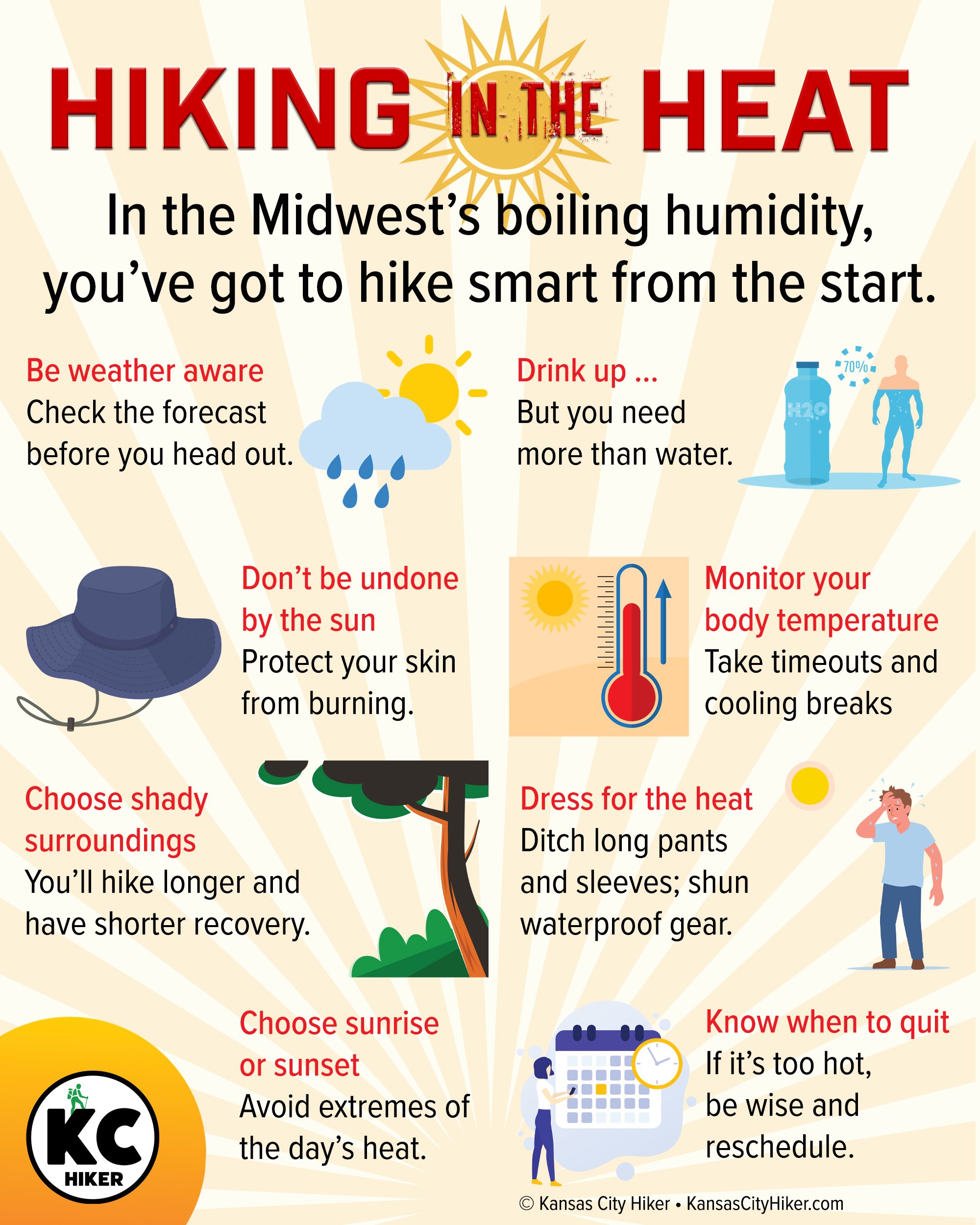
#1 Plan ahead: Be aware of the forecast – and humidity
Know what you’re up against. Be sure to look at the projected weather so you don’t inadvertently end up frying yourself and your crew. If you know it’s going to be a scorcher, you can prepare. But don’t get caught off guard. In addition to the actual temperature, be mindful of the humidity levels. Living in the Midwest, we’re “used” to humidity, but it’s something to be taken seriously. According to Backpacker Magazine:
“The climate starts to feel oppressive around 50-percent relative humidity, which means that the air is holding 50 percent of its maximum capacity for suspended water vapor. At 100 percent relative humidity, it’s completely saturated with moisture. Because it can’t hold any more water at this point, your sweat stops evaporating. Needless to say, hiking in 100 percent humidity is dangerous.”
#2 Mind the sun
Yes, this could be an opportunity to put the finishing touch on your tan. Or an opportunity to get completely fried and crispy (think pain every time you move). Tan if you must, but at least bring sunscreen, a hat and some sort of protection from the sun in case it’s more than you bargained for. This is especially true of any little ones in tow. You don’t know you’re baked until it’s too late. In addition to turning you red, the sun will contribute to the overall elevating of your body temperature and push you toward heat exhaustion and dehydration.

Seek out a shady trail when temperatures peak. Location: Rock Island Rail Trail, near U.S. 50, in Kansas City, Mo.
#3 The shade is your friend
You’ve got lots of options when walking outdoors. So pick a mostly shady trail. This will reduce your chances of heat exhaustion and dehydration. It will also extend the amount of time you can hike without hitting the wall. Avoid vast open spaces where you are slow cooking like those hot dogs at QT.
#4 Enjoy morning or evening hikes
This is a no brainer, but it’s all part of successful planning so you can actually enjoy your hike. Get up early or head out late to beat the worst of the day’s heat. If you have to drive to the trailhead, then allow time for this. It’s surprising how quickly the mornings can heat up, so make sure you leave enough time to get out and back before temperatures soar.

Kill Creek Park, Olathe, Kansas
#5 Hydration: More than water
It almost sounds cliché to say, “Stay hydrated.” But there’s more here than bringing a 16-ounce water bottle. Some of us are perpetually thirsty and drink every drop before we even start. Others don’t sweat much and don’t feel like drinking, even when it’s hot. Both types, however, are in danger of dehydration when it’s hot and humid. Water is great. But I also recommend something with some energy in it, like Gatorade, fruit juice or several of the nutrient-infused drinks on the market. There are also powdered mixes and effervescent tablets.
You can actually make your own Gatorade-type of drink and put it in a reusable bottle. Here is a recipe, but you can experiment and make your own. There are plenty of other recipes out there, but in general, they include some combination of:
Fruit juice
Kool-Aid
Sugar
Salt (go easy on this)
Herbal tea
Lemon/lime juice
I experimented until I found a blend I liked.
The reasons for going beyond water are that (1) often we don’t feel like drinking plain water when we’re overheated (2) sugar and salt help us recover and sustain us in the heat. There’s more here than a taste preference. Subsisting solely on pure water when sweating heavily can lead to a condition known as hyponatremia. In laymen’s terms, this is known as “water intoxication.” In can present as heat exhaustion, but its root is extremely low sodium levels in the body.
There’s a balance between forcing down too much water when it’s not needed and failure to drink when liquids are desperately needed.
And of course I don’t have to tell you to keep your drink cool. One option is to take two bottles and freeze one. Then a cold drink is still “on tap” when you finish the first one.
Oh, and you have to bring enough water. I find myself perpetually burning through all the water I bring, so I just picked up a 64-ounce bottle with a handle. It goes in one hand and my camera or phone goes in the other. If you don’t mind carrying a backpack full of bottles, then you don’t need this. Another option is a hydration pack, which you wear on your back like a regular backpack. There are lots of different sizes. I personally don’t like hydration packs because they’re difficult to clean and dry out. But I see them everywhere, so maybe it’s just me.
#6 Mind your body temperature
We’ve already discussed several ways to manage the heat, but the core issue is your body temperature. In addition to hydration, what can you do? A few things:
Take a break in the shade.
Take a break at a coffee shop or other air conditioned location.
Spray water in your face with a portable sprayer.
If you’re near a spigot, splash water in your face and douse your head (or whatever).
Jump into a lake or pool (of course you need to be prepared to finish your walk completely soaked, but it may be worth it).
Submerge part of your body – even your bare feet – in cool water. It makes a difference.
A less immersive approach is to soak a bandana in water and put it around your neck or head.
#7 Dress for the weather
There may be reasons some people wear long sleeves and long pants in the heat. However, if you don’t have to, don’t. Let your skin breathe (without frying your exposed skin in the sun). Waterproof clothing, including shoes, are generally made of some sort of polyester blend and can generate significant heat.
#8 Skip it and wait for another day
I hate to say this, but sometimes it’s just too dang hot – especially if you have health issues or are prone to heat exhaustion. Hit the gym instead. Or just lay low for a day or two. In the Midwest, the weather is constantly changing, so it’ll soon return in your favor.
Stool cool and carpe diem!
Roy Harryman is the publisher of Kansas City Hiker.
