Ticked off? Preventing and treating bites from ticks and no-see-ums in Kansas City
You can still enjoy the great outdoors in the Midwest and stay safe by taking a few precautions.
By Roy Harryman
Publisher
Let’s be honest: Ticks blow.
Even if they weren’t carriers of chronic diseases, the fact that they’re blood-sucking parasites is a total grossout.
But we can take ticks seriously without waving the white flag of surrender and confining ourselves to the indoors eight months a year.
Ticks are serious business. So let’s examine the threat they present and how we can wisely respond to it. (I’m not a doctor or entomologist, so if you have serious health concerns, please consult a professional.)
Why am I addressing this common topic? Because people can take one of two extremes. The first is, “Golly gee! There are ticks here in this waist-high grass in July. Who coulda’ thunk it!”
The second and opposite approach is: “There are ticks outside. Run for your lives. Seal the doors. Block out the sun!”
As with many things in life, a balanced approach is usually best.
Tick facts
Ticks can become active when the temperature consistently hits 40 degrees. They like woods, high weeds and brush. For Greater Kansas City, that means we can generally expect them from April-November. Unless they’ve been rendered inactive by cold temperatures, we should assume they’re active. Now, that does not necessarily mean that we must soak ourselves with repellant on a day with a high of 50F. It’s going to come down to our own tolerance for risk and our attractiveness to ticks (more on that later).
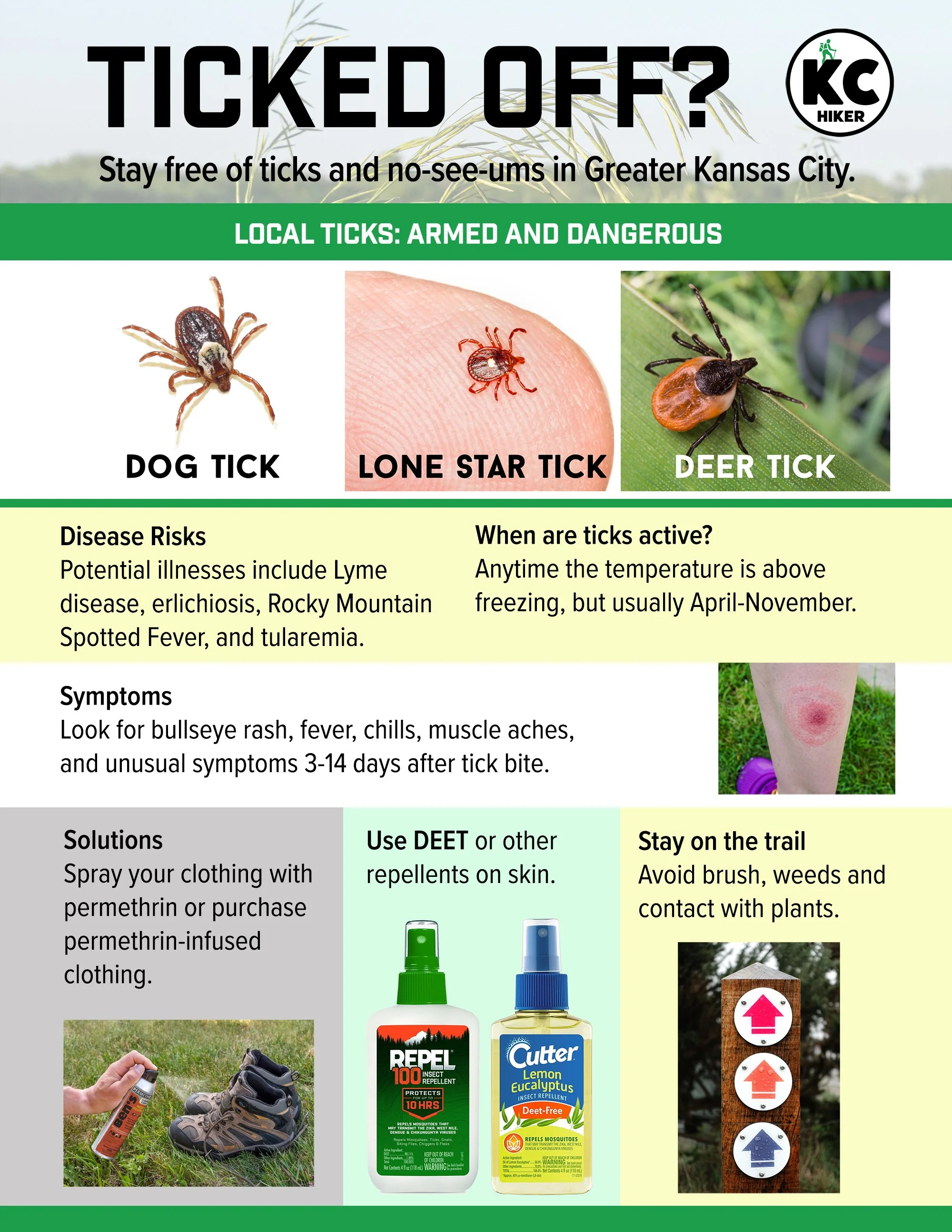
The main concern with ticks is that they can carry serious and chronic diseases (see the infographic below for specifics). To be bitten by a tick does not mean you will contract these diseases, but why give them a chance?

Staying on the trail and avoiding brushy side treks is the first line of defense against ticks and no-see-ums.
How to nix the ticks
Avoiding and repelling ticks requires a combination of actions and preventative measures. Note: Below are some affiliate links. Purchases made through them support Kansas City Hiker.
The first line of defense is to stay on the trail. Unless the pathway is overgrown, simply staying on the trail keeps you clear of contact with most ticks. Going off-trail (and I do it) increases the risk of brushing up against ticks.
The second line of defense is your clothing. Whether you’re wearing shorts or long pants, spray them with a chemical called permethrin. It’s odorless and does not harm clothes, but repels ticks and other insects. You can also buy clothing with permethrin baked into the fibers. Long pants and long sleeves, naturally, give ticks fewer options. But when it’s 85 degrees and sunny, this is not going to be realistic.
The final line of defense is repellent for your skin. DEET (found in Off!, Repel and other brands) is the most common. There are also differing levels of intensity. Deep Woods Off! and others contain a higher concentration of DEET. Read the labels and follow the directions so you don’t irritate your skin by overdoing it.
For those who don’t like DEET, there is an alternative chemical called picaridin which is marketed in brands including STEM. It’s still a repellent, but a kindler and gentler one. Eucalyptus and citrus blends also exist, but be sure to read the labels because many of them are mosquito repellents and don’t ward off ticks.
Where this gets complicated is if you’re sweating profusely. That can wash off repellents. If you’re anticipating a hard day on a hot trail, you’ll need to pack reinforcements and/or a change of clothes.
Making it work
This all sounds simple, but you have to do it. It’s easy, when you’re in a hurry, or maybe feeling lazy, to skip part of this regimen. I can be guilty of this. On a recent hike, time was a little short so I used DEET, but did not apply picaridin to my clothing. I ended up brushing off my first tick of the year. Coincidence?
Another safety tactic is to know yourself. Are you a “tick magnet”? In my interview with Dr. Todd Fristoe, we discussed that ticks seem to have “favorites.” That is, they seem to be attracted to some people’s body chemistry more than others. Here’s an anecdote in support of this theory. My two sons and I walked through a mowed area in late spring. Two of the three of us picked up zero ticks. The other picked up 30! We all sprayed with DEET. The lesson here? If you’re the tick magnet, take extra precautions. You may want to avoid the brushy trail completely, or make doubly sure you are thoroughly treated with repellent.
Here’s my routine
This works for me personally, but may not be best for you. (Again, I am not a scientist or physician.) If I know I’m headed into tick country, I’ll go down to the garage in my undergarments and spray myself with deet from head to toe. Then I’ll put on clothing coated in picaridin. And I’ll bring extra spray if I think I’m likely to sweat it off. So far, so good.
Other no-see-ums
The good news is that the same principles apply to other bugs. Chiggers do not present the health risks of ticks, but they can make us absolutely miserable. Diligent preparation for ticks can also prevent chigger bites.
Mosquitos – also carriers of diseases – can be thwarted with the same techniques. However, geography matters with mosquitos. They love moisture, humidity and low-lying areas. Ponds, puddles and even lakes and rivers are hotspots. You can encounter walls of mosquitos if you’re in the wrong place at the wrong time. If you find this is the case, bail out or wear mosquito netting.
So get out there . . .
. . . unless you shouldn’t. Beyond anything I’ve written here, rely on professional medical advice. In addition, we need to realize our limits. Regardless of how many times we’ve sprayed ourselves with repellent, we’re not invincible. Wandering through head-tall prairie grass in June is risky. Sleeping directly on the ground – whether in the woods or grass – may also be a nap you regret.
So be wise, pick your battles and be thorough. And be sure to enjoy the cooler seasons of the year that are tick and worry free.
An interview on tick bite prevention in Greater Kansas City with Dr. Todd Fristoe, MD
If you enjoy the outdoors in Kanas City, no doubt you’re familiar with “no-see-ums.” That’s a descriptor for tiny insects including ticks, chiggers and mosquitos that strike before you notice them. Yes, they’re annoying. But are they dangerous?
There’s a lot of concern about contracting Lyme’s Disease from ticks. How much concern should we have and what precautions should we take? And what about mosquitoes? Spiders? Chiggers? And others?
Dr. Todd Fristoe, MD, joins us from St. Luke’s Health Primary Care to answer these important questions for hikers, bikers and others who love nature. The short answer is: Yes! You can enjoy the outdoors without fear. But make sure you know insect bit prevention and how to treat problematic insect bites.
Tick prevention: Quick tips to stay safe
🐞 Local Tick Species: Three primary ticks in the area: black-legged (deer) tick, lone star tick, and dog tick. Each is capable of transmitting different diseases.
🩺 Disease Risks: Potential illnesses include Lyme disease, erlichiosis, Rocky Mountain Spotted Fever, and tularemia.
🚨 Symptoms to Watch: Look for bullseye rash, fever, chills, muscle aches, and unusual symptoms 3-14 days after tick bite.
🛡️ Prevention Strategies:
Stay on trail center, away from brush.
Use permethrin-infused clothing or apply permethrin to your clothing.
Apply DEET or EPA-approved insect repellents.
Use natural alternatives like oil of eucalyptus.
🩹 Medical Advice: Inform healthcare providers about outdoor activities and potential tick exposure.
🌿 Outdoor Enjoyment: Don't be afraid, just be prepared and cautious.
Overview of Interview on tick bite prevention with Dr. Todd Fristoe, MD
Introduction Introduction of Dr. Todd Fristoe, family physician
Ticks and Other Outdoor Menaces
Overview of ticks, chiggers, and their dangers- Importance of understanding risk levels
Types of Ticks in the Area
Black-legged tick (deer tick): Associated disease: Lyme disease, erlichiosis, Rocky Mountain Spotted Fever
Lone star tick: Associated diseases include erlichiosis, tularimia, Southern tick-associated rash illness
Dog tick: Potential for carrying tularimia
Symptoms and Medical Attention
Identification of Lyme disease and its bullseye rash; Other tick-borne illnesses and their symptoms; Importance of seeking medical attention after tick bites.
Risk of Tick-Borne Illnesses
Discussion on the incidence of tick-borne diseases in Jackson County; Comparison of disease seriousness vs. incident rates.
Preventive Measures Against Tick Bites
Staying on trails and avoiding brush; Use of Permethrin-infused clothing; Application of DEET and other insect repellents; Consideration of natural repellents (e.g., oil of lemon eucalyptus).
Effectiveness of Repellents
Comparisons between DEET and natural products; Importance of following product instructions and reapplication.
Susceptibility to Tick Bites
Discussion on varying susceptibility among individuals; Possible influence of blood type and pheromones on tick attraction.
Other Insects to Be Aware Of
Awareness of mosquitoes and potential diseases (e.g., encephalitis); General precautions for insect bites and bites from spiders.
Encouragement for Outdoor Activity
Importance of enjoying the outdoors with proper precautions; Recommendations for camping and nighttime activities.